What's Actually In Your Comms Cupboard (And Why Your Internet Is Bad)
Oct 13, 2026
What's Actually In Your Comms Cupboard (And Why Your Internet Is Bad)
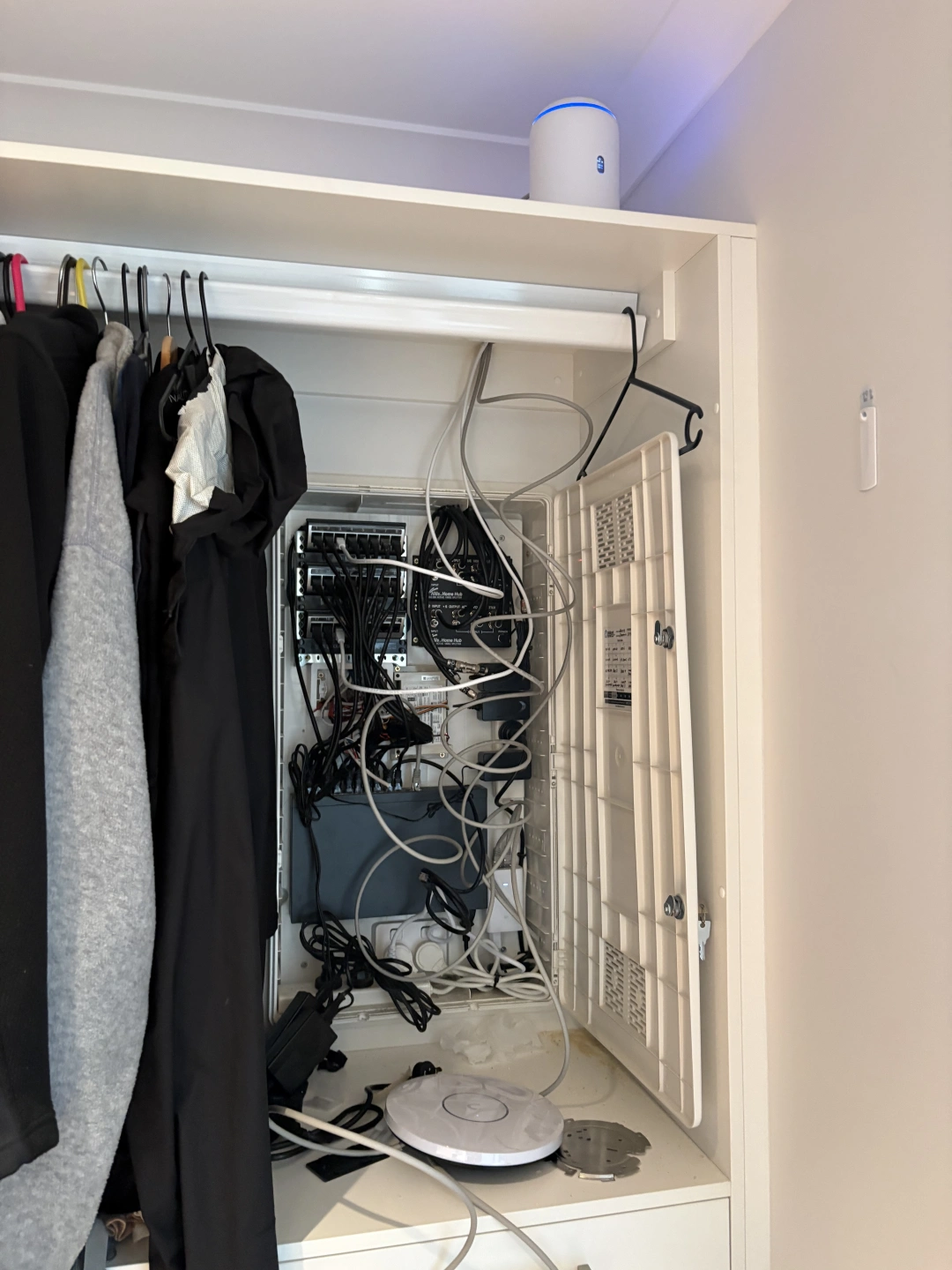
If your house was built in the last fifteen years, there's a good chance you've got a plastic box on a wall somewhere with a tangle of cables in it.
Most people have never opened it. If you have, you probably closed it again quickly.
We open these boxes constantly. Here's what's usually inside.
The Box Itself Is The First Problem
Most homes have a slimline enclosure — often Clipsal, and there's nothing wrong with the brand. It's the installer or the designer for promising the customer that everything can fit in a slim wall mount cabinet.
These boxes are designed to be discreet. They sit flush in a wall, they look tidy from the outside, and they're completely inadequate for what ends up inside them.
By the time a few services have been run through, the enclosure is overloaded. Cables are packed in tight, bent hard around corners, and pressed against the door. Shut the door and it's pushing on the cables. That's not a cosmetic issue — data cable has a minimum bend radius for a reason, and cramming it into a slimline box ignores that entirely.
Too Many Joins
This is the big one, and it's everywhere.
Data cable is not electrical cable. You can't just join it, tape it, and expect it to behave. Every join is a point of failure — a place where signal degrades, where impedance changes, where water and heat and movement all take their toll over time.
We regularly find data cables that have been cut and joined, sometimes more than once, usually because it was faster than running a new length. Sometimes it's a jelly crimp. Sometimes it's a punch-down join. Sometimes it's damage to the cable from things like having the roof replaced, rodent damage, etc.
Here's the thing: a join might test fine on the day. It might work for years. But it will never perform the way a continuous run does, and it won't hold up across the temperature swings a roof space or wall cavity sees over a decade. Things like packet loss - small interruptions to your internet, extra buffering, can be caused by joins in data cables.
Data cable is supposed to be a single continuous run from point to point. That's not a preference, it's how the standard works. Every join is a compromise someone made and didn't tell you about. The patch lead that you use to connect your device to the wall plate is supposed to be the part that fails.
The NBN Box Problem
This is the most common fault we see, and it's the one that causes the most confusion.
The NBN connection box gets installed. Usually in the Garage when the communications hub is upstairs. The technician re terminates the old cable used for telephone and repurposes it for data. Everyone assumes that's the end of it.
But the NBN box isn't a router. It's a handoff point — the line comes in, and from there it's your network's job to distribute the signal. If it's plugged into a box full of joined, unlabelled cabling with no switch and no management, then the NBN line can be perfect and your Wi-Fi will still be terrible.
We normally see the NBN installed in the garage and a cable run to the hub, then patched to a field outlet. The solution is to install the router closer to the NBN network termination device, or with less joins.
This is why so many people are told "there's nothing wrong on our end" and then spend months trying to fix a problem that isn't on the NBN's side at all.
What It Costs You
A mess like this doesn't usually fail outright. It degrades.
Speeds that don't match the plan. Dropouts that come and go. Devices that work in one room and not another. Rebooting the router as a daily ritual.
And because the mess is hidden behind a door, nobody suspects it. People replace routers, change providers, buy mesh systems — all while the actual problem sits in the wall, unlabelled, unmanaged, and joined in three places.
What We Do About It
We're happy to do the minimum required to get you stable, high-speed Wi-Fi. Sometimes that's all it takes.
But when we open a box and find this, we'll show you what's in there and explain what it means. Maybe the existing cabling can be remediated and reused. Maybe it needs replacing. Either way, you'll know what you've got — instead of guessing.
We test before we reuse. We label what we install. We don't join data cable and hope.
The Bottom Line
If you've never opened your comms cupboard, it's worth a look. If there's a tangle of cables, a door that pushes against them, or joins you can see — that's not normal, and it's not something to live with.
TechTV testimonial from 2026:
Kate S. "Absolutely superb, cannot recommend highly enough. We had the super fast NBN fitted, then guy said can’t connect it to your system, not my job🙄… found these guys online, they came and dealt with the problem swiftly. Very professional throughout the process and very courteously answered all my questions and explained things, I now understand that box of messy wires and what it does thanks to theses lovely guys!!!!"